
LSU Health New Orleans and Partners Announce Comprehensive Plan to Eliminate Cervical Cancer in Louisiana
The Bayou Blueprint provides data-driven 10-year plan to reduce cases by 2035
April 23, 2026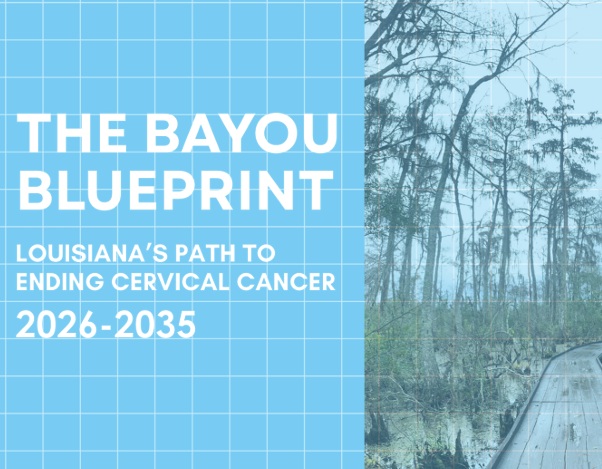
LSU Health New Orleans, in partnership with Louisiana Cancer Prevention and Control Programs (LCP) and other local and regional partners, today released the Bayou Blueprint: Louisiana’s Path to Ending Cervical Cancer (2026-2035). The plan represents a coordinated, data-driven roadmap developed in collaboration with healthcare providers, public health researchers, community organizations and cervical cancer survivors across the state.
LCP, housed within the LSU Health New Orleans School of Public Health, has led statewide cancer prevention and control efforts for more than two decades and serves as the backbone organization for this initiative.
The Bayou Blueprint, as one of only two cervical cancer elimination plans to be released nationally, establishes measurable goals and evidence-based strategies to reduce Louisiana’s cervical cancer rate from 8.9 cases per 100,000 to fewer than 4 cases per 100,000 by 2035, meeting the World Health Organization’s definition for elimination.
“No one in Louisiana should die from cervical cancer. This disease is preventable and, when caught early, highly treatable,” said Donna Williams, director of LCP. “The Bayou Blueprint provides multiple entry points for action to guide responsive, localized efforts across the state. Everyone has a role to play in reducing the burden of this cancer.”
Despite relatively high cervical cancer screening rates, Louisiana ranks 7th in the U.S. for new cases of cervical cancer and 7th for deaths. Each year, about 215 people in Louisiana are diagnosed with cervical cancer. The state’s five-year survival rate of 64.4% falls below the national average of 67.3%, underscoring a critical gap between diagnosis and outcomes.
When examining Louisiana cervical cancer data by race, non-Hispanic Black women have the highest rate of new cancer cases (10.5 per 100,000), followed by Hispanic (9.8) and Asian women (9.2), compared with non-Hispanic White women (8.1). Mortality rates show even greater gaps: non-Hispanic Black women experience nearly double the death rate of non-Hispanic White women (4.1 vs. 2.3 per 100,000).
These disparities are further compounded by geography, as rural communities face significantly greater barriers to screening access, specialist availability and follow up care.
The Bayou Blueprint is structured around three pillars of cervical cancer elimination:
- Prevention Through HPV Vaccination. The plan aims to increase HPV vaccination completion rates among Louisiana adolescents ages 13 to 17 from the current 66.8% to 80% by 2035. HPV is the primary cause of nearly all cervical cancers.
- Screening and Early Detection. The Bayou Blueprint targets an increase in up-to-date cervical cancer screening among Louisiana women ages 21 to 65 from 73.8% to 80% by 2035.
- Follow-Up and Treatment. The initiative targets 80% adherence to follow-up care after abnormal screening results by 2035.
The Bayou Blueprint is aligned with the HPV Vaccination Roundtable of the Southeast, supported by the St. Jude HPV Cancer Prevention Program, to ensure consistency and strengthen regional collaboration. Louisiana’s is the second state-wide plan to be released in the United States, following Alabama’s OPERATION WIPE OUT, launched in 2023.
“LSU Health New Orleans exists to improve the health of Louisiana’s communities through innovative research and education. As only the second plan to be released nationally, the Bayou Blueprint speaks to our unwavering commitment to that mission,” said Dr. David S. Guzick, senior vice chancellor of LSU Health New Orleans. “The elimination of cervical cancer in Louisiana is achievable in our generation. We are proud to work alongside our partners to make this vision a reality.”
For more information on the Bayou Blueprint and the work of LCP, visit louisianacancer.org. To learn more about the services and research of LSU Health New Orleans, visit lsuhsc.edu.
###
About LSU Health New Orleans
LSU Health New Orleans educates Louisiana's health care professionals. The state's
health sciences university leader, LSU Health New Orleans includes a School of Medicine
with campuses in Baton Rouge and Lafayette, the state's only School of Dentistry,
Louisiana's only public School of Public Health, and Schools of Allied Health Professions,
Nursing, and Graduate Studies. LSU Health New Orleans faculty take care of patients
in hospitals and clinics throughout the region. In the vanguard of biosciences research,
the LSU Health New Orleans research enterprise generates jobs and enormous annual
economic impact. LSU Health New Orleans faculty have made lifesaving discoveries and
continue to work to prevent, advance treatment and cure disease.